
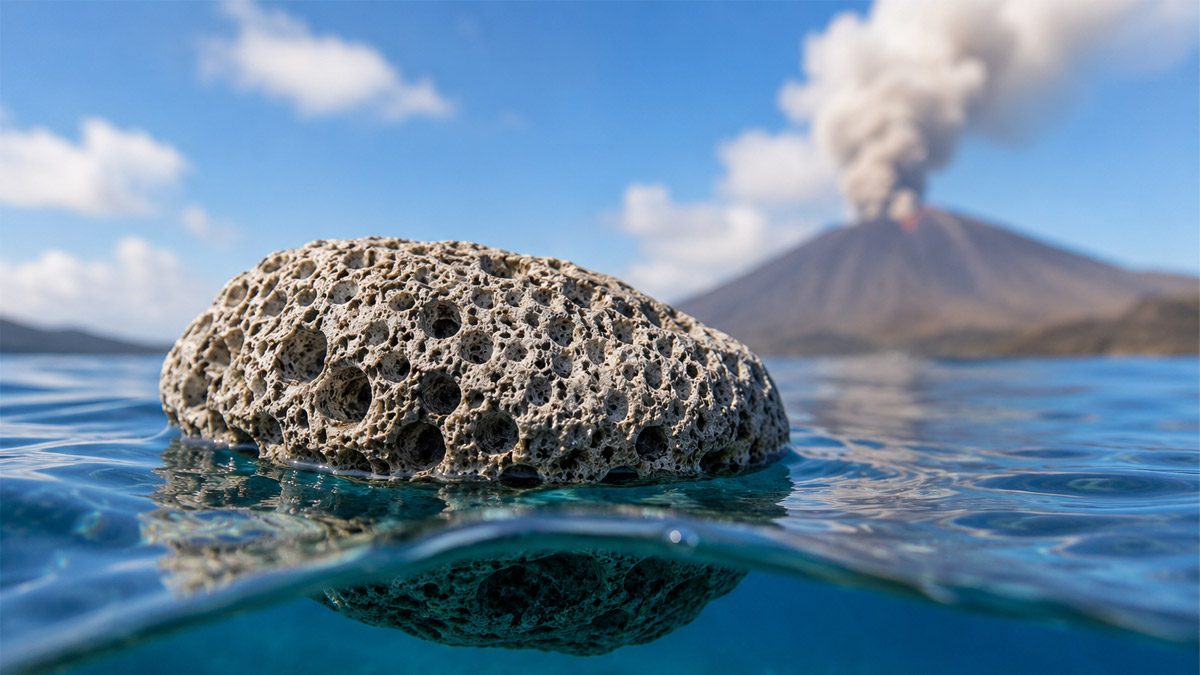
At first glance, a rock floating on water seems impossible. Rocks are usually associated with something heavy, dense, and firmly settled at the bottom of a river, lake, or ocean.
Yet there is one remarkable exception: pumice.
This unusual volcanic rock can float on water for surprisingly long periods. Its secret isn’t that pumice is somehow “lighter than water” in the ordinary sense. Instead, its structure is filled with countless tiny holes created during volcanic eruptions.
That unusual combination of volcanic material and trapped gas gives pumice one of the strangest properties found in the world of rocks.
What Is Pumice?
Pumice is a light-colored volcanic rock that forms when gas-rich magma reaches the Earth’s surface and cools rapidly.
During an explosive eruption, magma can contain large amounts of dissolved gases. When the pressure suddenly drops as magma rises toward the surface, those gases expand and form bubbles.
If the magma cools quickly enough, the bubbles become trapped inside the solidifying material.
The result is a rock that looks almost like frozen foam.
Under a microscope, pumice can reveal a complex network of pores and cavities. These spaces dramatically reduce the rock’s overall density compared with many other types of volcanic rock.
Why Can a Rock Float?
The key is density.
An object floats when its average density is lower than the liquid it is placed in. Freshwater has a density of roughly 1 gram per cubic centimeter, while many common rocks have substantially higher densities.
Pumice is different because a large portion of its volume can consist of empty spaces.
Think about a sponge.
The solid material making up a sponge may be denser than water, but the sponge as a whole can float because it contains so much air.
Pumice works according to a similar principle.
Its solid volcanic material is mixed with a huge amount of microscopic and macroscopic pores. The combined structure can have a sufficiently low average density to allow the rock to remain at the surface.
How Does Volcanic Rock Become So Full of Holes?
The story begins deep beneath Earth’s surface.
Magma contains dissolved gases, including water vapor and carbon dioxide. While magma remains under high pressure underground, these gases can stay dissolved within it.
As magma rises, pressure decreases.
That reduction in pressure allows dissolved gases to expand and form bubbles.
If the magma erupts violently and cools rapidly, those bubbles can become trapped before they have time to escape.
This process is called vesiculation, and the resulting cavities are known as vesicles.
The more extensive the vesicular structure, the more porous the resulting volcanic rock can become.
Why Doesn’t All Volcanic Rock Float?
Volcanic rocks don’t all form under the same conditions.
Some lava flows cool relatively slowly, allowing gases to escape before the material completely solidifies. Other magma may contain fewer dissolved gases to begin with.
Basalt, for example, can contain vesicles, but it is generally much denser than pumice.
Pumice forms under a particularly favorable combination of conditions:
- Gas-rich magma
- Rapid pressure reduction
- Extensive bubble formation
- Rapid cooling
- Trapping of gas-filled cavities
These conditions create a highly porous volcanic material.
Can Pumice Really Float for Months?
Sometimes, yes.
Large pieces of pumice can remain afloat for extended periods, particularly when their pores initially contain air.
But pumice doesn’t necessarily float forever.
Over time, water can enter some of the pores and replace trapped air. As the rock becomes saturated, its effective density can increase.
Eventually, a piece of pumice may become waterlogged and sink.
How long this takes depends on factors such as the rock’s porosity, pore structure, size, and how easily water can penetrate its interior.
The Incredible Case of Pumice Rafts
Pumice becomes even more fascinating when huge quantities of it are produced during volcanic eruptions.
In some circumstances, volcanic eruptions can generate enormous amounts of floating pumice. Ocean currents can then carry these fragments across large distances.
The resulting accumulation is sometimes called a pumice raft.
Pumice rafts can cover large areas of the ocean surface and may travel with currents.
Scientists have studied these floating masses because they provide a fascinating natural example of how geological processes can interact with ocean ecosystems.
Pumice Can Even Transport Marine Life
A floating pumice fragment isn’t simply an inert object drifting through the ocean.
Its rough, porous surface can provide temporary habitat for organisms such as algae, barnacles, and other small marine organisms.
When large pumice rafts travel across the ocean, they can potentially transport organisms with them.
This creates an unusual connection between volcanology and marine biology.
A rock born during an explosive volcanic eruption can eventually become a floating platform for life.
Why Does Pumice Have Such a Rough Texture?
The familiar rough texture of pumice comes from its highly vesicular structure.
As gas bubbles form and become trapped, they leave behind cavities within the solidifying volcanic material.
Some cavities are microscopic, while others can be large enough to see with the naked eye.
This gives pumice its characteristic lightweight, abrasive texture.
That abrasiveness is also why pumice has been used for centuries as a natural abrasive material.
What Is Pumice Used For?
Pumice isn’t just a geological curiosity.
Its lightweight and abrasive properties make it useful for several purposes, including:
- Removing rough or hardened material from surfaces
- Abrasive products
- Landscaping
- Lightweight construction materials
- Horticultural soil mixtures
- Certain cosmetic and personal-care applications
In gardening, crushed pumice can help improve drainage and aeration because its porous structure creates spaces within soil.
Is Pumice Actually a “Light” Rock?
This is where the science gets interesting.
Pumice isn’t necessarily made from a material that is intrinsically less dense than every other volcanic rock.
Its ability to float primarily comes from its overall structure.
Imagine taking a solid block of volcanic glass and filling it with countless tiny air pockets. The amount of empty space can dramatically lower the average density of the entire object.
So when you see pumice floating on water, you’re essentially seeing the effects of porosity and density working together.
Pumice vs. Other Volcanic Rocks
Different volcanic rocks can have dramatically different textures and densities.
| Rock | Typical Characteristic | Can Float? |
|---|---|---|
| Pumice | Extremely porous and vesicular | Often yes |
| Basalt | Dense, dark volcanic rock | Generally no |
| Obsidian | Dense volcanic glass | No |
| Scoria | Porous volcanic rock, usually darker | Sometimes, depending on density |
| Rhyolite | Fine-grained, silica-rich volcanic rock | Generally no |
The important distinction is that porosity can dramatically change a rock’s bulk density.
What Does Floating Pumice Tell Scientists?
Pumice provides more than an unusual visual spectacle.
Its structure preserves clues about what happened during a volcanic eruption.
By studying pumice, scientists can investigate:
- How much gas was dissolved in magma
- How rapidly magma decompressed
- How explosive an eruption may have been
- How quickly volcanic material cooled
- How bubbles formed and expanded within magma
In other words, a small piece of floating rock can contain evidence about an enormous geological event.
The Strange Science Behind an “Impossible” Rock
Pumice is a reminder that appearances can be misleading.
A rock seems like the ultimate symbol of heaviness and solidity. Yet under the right geological conditions, volcanic material can become so porous that it floats on water.
The secret lies in the bubbles.
Gas-rich magma rises, pressure falls, bubbles expand, and rapid cooling locks those bubbles into place. The resulting network of pores can reduce the rock’s average density enough to keep it afloat.
Eventually, water may penetrate those spaces and cause the pumice to sink—but until then, this unusual volcanic rock can behave more like a piece of foam than a stone.
And that’s what makes pumice so fascinating: one of Earth’s most solid-looking materials can, under the right circumstances, float.
Frequently Asked Questions
Why does pumice float on water?
Pumice can float because its highly porous structure contains numerous air-filled cavities. These spaces reduce its overall density, sometimes making it lower than the density of water.
Is pumice the only rock that can float?
No. Some other highly porous volcanic materials, including certain types of scoria, can float if their overall density is sufficiently low.
Does pumice eventually sink?
It can. Water may gradually enter its pores and replace trapped air, increasing its effective density until the rock becomes unable to remain afloat.
How is pumice formed?
Pumice forms when gas-rich magma undergoes rapid decompression and cooling, trapping numerous gas bubbles inside the solidifying volcanic material.
Why is pumice full of holes?
The holes are called vesicles. They form when gases dissolved in magma expand into bubbles and become trapped as the magma rapidly cools.
Can pumice be found in the ocean?
Yes. Volcanic eruptions can produce enormous quantities of pumice that float across oceans and sometimes form large pumice rafts.